Collection Universal Symbol Silhouettes
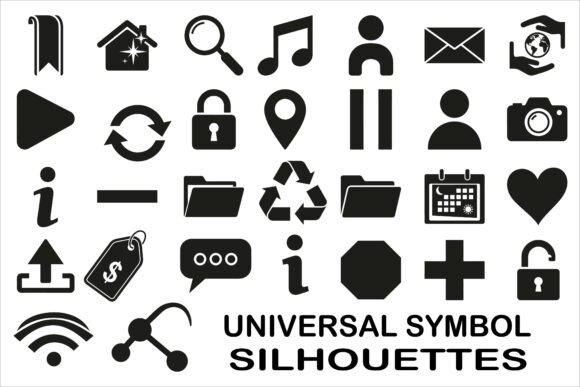
Collection Universal Symbol Silhouettes is a curated set of 30 standardized, culturally resonant icons rendered as clean black silhouettes. Each symbol represents a concept or object widely recognized across linguistic and geographic boundaries—such as a heart for love, a house for home, a globe for global connection, or an arrow for direction. The collection includes identical representations across six file formats: SVG, EPS, AI, PDF, PNG (with transparent background), and JPG—totaling 180 files (30 per format).
This resource is designed for professionals who require consistent, legible, and adaptable visual shorthand. It serves functional roles in signage systems, educational materials, data visualization, branding guidelines, wayfinding design, and digital interface components. Its emphasis on silhouette form prioritizes clarity at small sizes and scalability without loss of fidelity.
Why Consider Collection Universal Symbol Silhouettes?
Designers, educators, UX researchers, and communication specialists often face recurring challenges: conveying meaning quickly, supporting multilingual audiences, maintaining visual consistency across media, and reducing cognitive load. Symbols that operate independently of text help address these needs—especially where language barriers exist or literacy levels vary.
A user evaluating this collection may be weighing whether its specific scope and execution meet project requirements. Key considerations include the universality of individual symbols, stylistic coherence, technical compatibility, and licensing clarity. Unlike generically sourced icons, this collection emphasizes deliberate selection and uniform rendering—reducing time spent editing mismatched assets or reconciling inconsistent stroke weights and proportions.
Practical Benefits and Real-World Utility
The primary benefit lies in efficiency and reliability. Because all 30 symbols share the same visual language—flat, unembellished, high-contrast silhouettes—they integrate seamlessly into layered compositions such as infographics or interactive dashboards. SVG and AI files support infinite scaling, making them suitable for both mobile app icons and large-scale transit signage. PNG files with transparency simplify layering over photographs or gradients in print layouts or web banners.
Educational applications benefit from the collection’s conceptual clarity. In classroom posters or accessibility tools, simplified forms aid comprehension for learners with varying cognitive or linguistic backgrounds. Wayfinding designers use such symbols to reinforce directional cues without relying solely on text—critical in airports, hospitals, or public campuses where users may be stressed, distracted, or non-native speakers.
Branding teams may leverage the collection during early-stage identity development. While final logos typically evolve beyond stock elements, universal silhouettes serve as stable reference points during stakeholder workshops or user testing—helping align teams around core concepts before custom illustration begins.
Tradeoffs and Important Considerations
No single icon set satisfies every context. Collection Universal Symbol Silhouettes intentionally avoids decorative detail, gradients, or stylistic variation. That restraint supports versatility but limits expressive range. A project requiring warmth, personality, or cultural specificity—such as a children’s health initiative using regionally familiar motifs—may need supplemental custom illustration.
Universality is also contextual. While symbols like “circle + line” for “no” or “door” for “entrance” have broad recognition, interpretation can shift across regions. For example, the “hand” silhouette may signal “stop,” “help,” or “touch interaction,” depending on surrounding cues. Users should verify symbol meaning with target audiences—not assume cross-cultural alignment without testing.
File organization matters in practice. Though the collection delivers 30 files per format, users must confirm naming conventions match their workflow (e.g., consistent prefixing, logical grouping). Some vector editors handle EPS and AI files differently; verifying compatibility with current software versions prevents unexpected rendering issues.
When This Collection Is a Strong Fit
Collection Universal Symbol Silhouettes works well for projects where speed, neutrality, and technical flexibility are priorities. Examples include:
- Developing internal documentation templates used across departments or countries;
- Building modular design systems that rely on reusable, format-agnostic assets;
- Creating public-facing safety signage compliant with ISO 7001 or ADA standards;
- Prototyping low-fidelity wireframes where placeholder icons must communicate function clearly;
- Producing bilingual or multilingual educational handouts where text reduction improves readability.
In each case, the value stems from predictable output—not novelty. If the goal is rapid iteration with minimal asset management overhead, this collection reduces decision fatigue and ensures baseline visual harmony.
When Alternatives May Be Worth Exploring
Projects demanding strong brand differentiation or narrative depth may benefit more from custom iconography. A financial services platform emphasizing trust and innovation, for instance, might require bespoke symbols that reflect proprietary values—not generic abstractions.
Similarly, highly regulated sectors—such as medical device labeling or aviation manuals—often follow strict iconographic standards (e.g., IEC 60417). In those cases, compliance takes precedence over aesthetic cohesion, and users should consult domain-specific symbol libraries first.
Open-source alternatives like Font Awesome or Noun Project offer broader quantity and community updates—but introduce variability in style, licensing terms, and technical implementation. Collection Universal Symbol Silhouettes trades breadth for consistency: fewer symbols, unified treatment, and guaranteed format parity.
Making an Informed Decision
To determine whether Collection Universal Symbol Silhouettes aligns with your goals, ask three questions:
- Do your use cases prioritize clarity and cross-context legibility over stylistic uniqueness? If yes, the collection’s minimalist approach supports that objective.
- Will you deploy assets across multiple output channels—print, web, large-format signage—and need reliable scalability? SVG, EPS, and AI files address this directly.
- Is your timeline constrained, and do you lack capacity for custom icon development or extensive testing? Pre-vetted, production-ready files reduce implementation risk.
If two or more answers are affirmative, the collection likely offers practical utility. If not, it may serve better as a starting point for adaptation rather than a final solution. Reviewing the full symbol list against your content map—and testing key icons with representative users—provides concrete evidence for selection.
Ultimately, Collection Universal Symbol Silhouettes functions as infrastructure: invisible when working well, noticeable only when misapplied. Its strength lies not in standing out, but in enabling other elements—text, color, layout, interaction—to communicate more effectively.