50 Genetic Strand DNA Vector Bundle: A Practical Resource for Science Communication and Visual Design
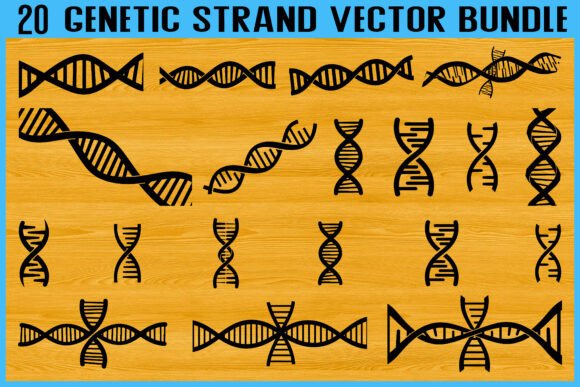
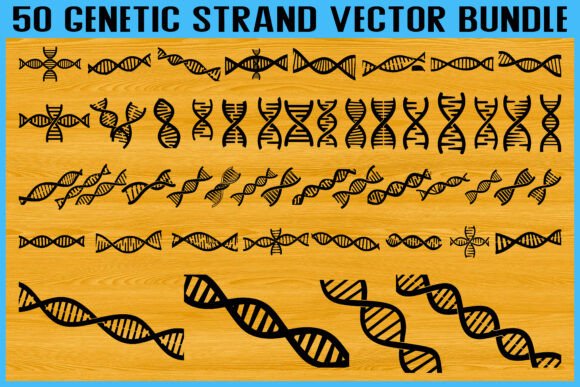
The 50 Genetic Strand DNA Vector Bundle is not just another design asset pack—it’s a thoughtfully curated toolkit built for clarity, adaptability, and scientific fidelity. Unlike generic biology-themed graphics that sacrifice accuracy for aesthetics, this collection bridges the gap between molecular precision and visual utility. Each of the 50 designs interprets DNA structure—whether canonical double helices, stylized base-pair motifs, or abstracted genetic patterns—with intentionality. The result is a set of vector assets that serve both functional needs (e.g., labeling a genetics lecture slide) and expressive goals (e.g., designing a lab’s brand identity).
Why Vector Format Matters in Scientific Visualization
Vector graphics are foundational to effective science communication—not because they’re trendy, but because they solve persistent problems. Raster images (like standard JPGs or PNGs) pixelate when enlarged; a DNA helix used on a conference banner may appear jagged or blurry if sourced from a low-resolution file. In contrast, every SVG, EPS, and AI file in the 50 Genetic Strand DNA Vector Bundle retains crisp edges at any scale—from thumbnail icons on mobile apps to 6-foot-wide exhibition panels. This scalability isn’t theoretical: educators printing classroom posters, medical illustrators preparing journal figures, and UX designers building responsive health dashboards all rely on resolution-independent assets to maintain professionalism across contexts.
Beyond scalability, vector files support deep customization. Stroke weight, color gradients, node placement, and layer organization can be adjusted without degradation. For instance, a researcher illustrating CRISPR-Cas9 targeting might isolate the helix backbone in one layer and the guide RNA motif in another—then recolor each to match publication guidelines. That level of control is impossible with flattened raster formats—and rare even among vector bundles that prioritize quantity over editability.
Diverse Interpretations, Unified Purpose
The “50” in the 50 Genetic Strand DNA Vector Bundle reflects deliberate variety—not repetition. You’ll find representations spanning three conceptual categories:
- Anatomical fidelity: Double-helix forms modeled after B-DNA geometry—right-handed twists, consistent major/minor grooves, and proportional base stacking. These suit peer-reviewed materials, grant proposals, or anatomy textbooks where structural correctness reinforces credibility.
- Abstract synthesis: Geometric interpretations—interlocking ribbons, tessellated nucleotide shapes, or circuit-like helical paths. These resonate in tech-forward contexts: biotech startup websites, data visualization dashboards tracking genomic datasets, or interactive museum exhibits explaining inheritance patterns.
- Pattern-based applications: Seamless DNA-inspired repeats, border elements, and background textures. These extend utility beyond focal illustrations—think letterhead for a genetics department, fabric prints for lab coats, or subtle watermarking on educational PDF worksheets.
This diversity ensures the bundle avoids visual fatigue. A single presentation won’t rely on the same helix angle or color scheme across ten slides. Instead, users can rotate between complementary styles—using a minimalist line-art strand for a title slide, then switching to a gradient-filled helix for an explanatory diagram—while maintaining cohesive branding through consistent stroke weight or palette logic.
Real-World Implementation Across Disciplines
How professionals actually use the 50 Genetic Strand DNA Vector Bundle reveals its cross-sector value:
Educators Building Accessible Learning Materials
Teachers curating open educational resources (OER) often face copyright constraints with stock imagery. With this bundle, a high school biology instructor can create custom worksheets showing DNA replication forks, transcription bubbles, or mutation types—all using editable vectors. Because each design includes transparent-background PNGs, they integrate cleanly into Google Slides or Canva without manual clipping. More importantly, the AI and SVG files allow educators to simplify complex structures—removing labels, thickening lines for projector visibility, or adding Braille-compatible tactile outlines for inclusive classrooms.
Researchers Communicating Complex Concepts
Scientists preparing conference posters or funding submissions need visuals that distill nuance without oversimplifying. One user reported adapting a coiled “chromosome scaffold” vector from the bundle to visualize chromatin looping in a Nature Communications submission—modifying anchor points to mirror Hi-C contact map data. Another repurposed a segmented helix as a timeline metaphor for evolutionary divergence, coloring segments by clade. These adaptations succeed because the underlying vector architecture supports meaningful modification—not just cosmetic recoloring.
Designers Crafting Trustworthy Brand Identities
In healthcare and biotech, visual trust is non-negotiable. Generic “sciencey” clipart undermines authority. The 50 Genetic Strand DNA Vector Bundle provides alternatives grounded in recognizable biomolecular language—helical pitch, groove asymmetry, and phosphate-backbone rhythm—that signal domain awareness. A diagnostics company used a monochrome helix variant as a favicon, then extended it into a full brand system: animated loading spinners mimicking unwinding DNA, UI icons derived from nucleotide shapes, and trade-show backdrops built from scaled pattern tiles. Consistency emerged organically—not from forced templating, but from shared visual DNA.
Technical Considerations Beyond File Counts
The inclusion of 50 SVG, 50 EPS, 50 AI, 50 PNG, 50 JPG, and 50 PDF files isn’t about padding numbers—it addresses real workflow fragmentation. Designers using Figma or Sketch may prefer SVG imports; print production teams require CMYK-ready EPS; academic publishers often mandate PDF figure submissions; and social media managers need instantly deployable JPGs optimized for Instagram carousels. Having all formats natively aligned (same dimensions, consistent naming, identical visual intent) eliminates hours spent converting, aligning, or troubleshooting mismatches.
Equally critical is optimization. Some vector bundles bloat file sizes with unnecessary layers, embedded fonts, or redundant anchor points—slowing Illustrator performance or causing export errors. These 50 Genetic Strand DNA Vector Bundle files are pre-optimized: minimal path complexity, cleaned groups, and standardized artboard sizing. Users report opening AI files directly in Affinity Designer or Inkscape without compatibility hiccups—a practical advantage when collaborating across software ecosystems.
Integrating Into Existing Workflows
Adoption hinges less on novelty and more on frictionless integration. Here’s how users embed the bundle without disrupting established practices:
- For educators: Drag-and-drop SVGs into LMS platforms like Moodle or Canvas. Use PNG variants for Word-based handouts where vector support is limited.
- For developers: Embed SVG code directly into HTML/CSS for responsive scientific web apps—applying CSS transforms to animate helix rotation or color transitions based on user interaction.
- For print producers: Place EPS files into InDesign layouts at 100% scale, then export press-ready PDF/X-4 with embedded ICC profiles—no intermediate rasterization needed.
- For presenters: Insert high-DPI PNGs into PowerPoint or Keynote, then use built-in morph transitions to simulate DNA strand separation or protein binding.
This interoperability stems from intentional standardization—not just across formats, but across semantic naming. Files are labeled descriptively (“dna_helix_twist_45deg”, “abstract_nucleotide_pattern_tile”) rather than cryptically (“vector_027”), reducing time spent hunting for the right asset during deadline pressure.
Ethical and Pedagogical Alignment
Science visualization carries ethical weight. Misrepresented DNA structures—exaggerated grooves, incorrect handedness, or anachronistic base pairings—can subtly reinforce misconceptions. The 50 Genetic Strand DNA Vector Bundle avoids these pitfalls by grounding abstractions in structural biology principles. While stylized, no design contradicts core knowledge: helices remain right-handed, sugar-phosphate backbones follow expected trajectories, and base pairing logic remains visually legible (even when simplified). This alignment matters most in educational settings, where first impressions shape long-term mental models.
It also supports accessibility by design. High-contrast variants, scalable line weights, and uncluttered compositions meet WCAG 2.1 AA standards for visual clarity. When paired with alt-text describing structural relationships (“double helix with labeled major groove and antiparallel strands”), these vectors become inclusive tools—not decorative afterthoughts.
Looking Ahead: Beyond Decoration Toward Utility
The enduring value of the 50 Genetic Strand DNA Vector Bundle lies in its refusal to be merely ornamental. It functions as infrastructure: a reusable layer in the communication stack that sits between raw data and human understanding. As fields like spatial transcriptomics, synthetic biology, and AI-driven protein folding accelerate, the need for accurate, adaptable, and ethically grounded visual language grows—not shrinks. Bundles like this don’t replace expertise; they amplify it. They let a clinician focus on patient education instead of Illustrator tutorials, empower a student to visualize epigenetic marks without coding skills, and give a designer freedom to innovate within scientifically literate boundaries.
In essence, the 50 Genetic Strand DNA Vector Bundle succeeds because it treats DNA not as a cliché, but as a living vocabulary—one that can be spoken precisely, adapted thoughtfully, and shared widely.