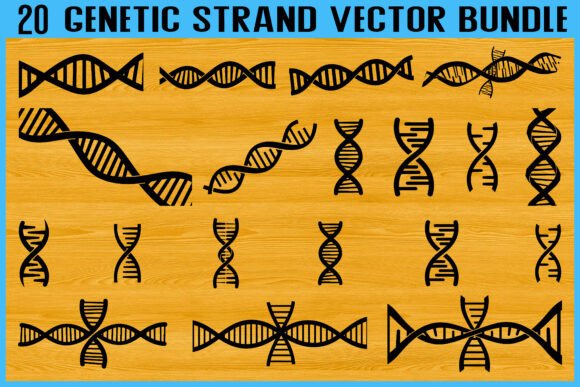
20 Genetic Strand DNA Vector Bundle
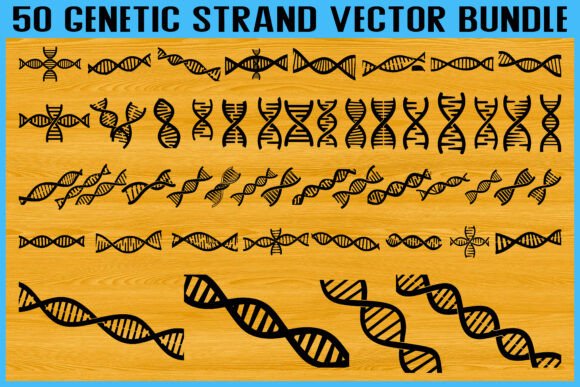
The 20 Genetic Strand DNA Vector Bundle is a purpose-built asset collection designed to support precision, clarity, and visual consistency in science-adjacent work — not as decorative filler, but as functional infrastructure. It enters workflows where accuracy matters: when illustrating molecular concepts for a textbook, designing an educational app interface, preparing a biotech investor pitch deck, or building branded merchandise for a university lab outreach program. Its value isn’t in novelty alone — it’s in how reliably it integrates into existing tools, timelines, and quality standards.
Where This Bundle Fits Into Real Workflows
Unlike generic clipart or one-off icons, the 20 Genetic Strand DNA Vector Bundle functions best when aligned with defined project phases. Before production begins — say, during wireframing a biology e-learning module — designers pull SVG files into Figma or Adobe XD to test layout proportions and color contrast. During content development, educators embed high-res PNGs directly into Google Slides or Canva presentations without worrying about pixelation on large displays. After final approval, marketing teams repurpose the same AI files to adapt a double-helix motif into a responsive website banner, a trade show backdrop, or packaging for a genetics-themed notebook line.
This isn’t a “set and forget” resource. Its strength lies in repeatability across formats and fidelity across scales — which means it supports iterative design, version control, and cross-platform publishing without rework.
Compatibility That Saves Time, Not Creates Friction
All 20 designs come in six native formats: SVG, EPS, AI, PNG, JPG, and PDF. That’s not redundancy — it’s workflow coverage. SVG handles web responsiveness and dynamic styling via CSS. EPS and AI preserve vector integrity for print vendors or complex Illustrator-based branding systems. PNG delivers transparency and resolution independence for digital publishing platforms that don’t accept vectors. JPG ensures broad compatibility with CMS editors, email builders, and social media schedulers. PDF serves dual roles: quick client previews and print-ready handoffs to commercial printers.
You don’t need to convert files unless your tool lacks native support — and even then, conversion is predictable. Inkscape opens EPS and SVG natively. Affinity Designer imports AI (with minor layer flattening). Preview apps render PDF instantly. No third-party plugins, no licensing gates, no cloud dependencies.
Customization Without Compromise
Each vector is built with clean anchor points, minimal path complexity, and logically grouped layers — meaning you can isolate a single strand, recolor a helix turn, or delete background elements in under 30 seconds. There’s no embedded raster masking or uneditable text blocks. Strokes are outlined or editable; gradients are flat or easily swapped for solid fills. If your brand palette uses Pantone 294 C and Warm Gray 11, you apply those globally across all 20 files using Illustrator’s Recolor Artwork tool — no manual swatch replacement needed.
This level of editability matters most when consistency is non-negotiable: imagine updating a university’s entire suite of genetics course materials over a semester. With this bundle, one color change propagates cleanly across lecture slides, lab handouts, and LMS banners — because the source structure is uniform, not improvised.
Use Cases That Reflect Actual Demand
- Educators use the transparent PNGs to build interactive drag-and-drop activities in H5P or Moodle — pairing visuals with terminology without sourcing mismatched assets.
- Healthcare startups embed EPS versions into FDA submission documents where vector scalability ensures legibility at 300 DPI on A4 and legal-sized pages alike.
- Freelance UI designers drop SVGs into React components with
tags, applying CSS transitions for subtle hover animations on genetic pathway navigation menus. - Small publishers batch-export AI files to CMYK PDF/X-4 via Illustrator’s Export for Screens — prepping all 20 illustrations for offset printing in one pass.
- Science communicators combine abstract DNA shapes from the bundle with custom typography in Canva to produce shareable Instagram carousels explaining CRISPR mechanisms — no illustrator required.
Efficiency Gains You Can Measure
Time saved isn’t theoretical. One curriculum developer reported cutting illustration prep time by 65% when switching from commissioning custom vectors to using this bundle — not because the art is “good enough,” but because it’s fit for purpose: scientifically plausible, stylistically cohesive, and technically robust. Another biotech marketing team reduced file-handoff revisions by 80% after standardizing on the AI format for all internal creative requests — eliminating miscommunication about stroke weight, layer naming, or export settings.
That efficiency compounds. Once you’ve established a naming convention (e.g., dna_helix_twist_03_ai), organized the folder structure, and added metadata in Bridge or Spotlight, retrieval becomes instantaneous. No scrolling through stock libraries. No licensing checks per usage. No resizing guesswork.
Long-Term Usability and Quality Control
These aren’t trend-driven illustrations. The clean, bold vector style avoids photorealism or excessive detail — making them resilient across evolving display technologies and accessible to users with low-vision needs when paired with sufficient contrast. All files meet WCAG 2.1 AA contrast minimums when used against standard backgrounds. The double-helix forms follow widely accepted conventions (right-handed B-DNA representation, consistent base-pair spacing) — important for credibility in academic or clinical contexts.
Because every file is individually crafted — not algorithmically generated — there’s zero risk of duplicated paths, stray anchors, or hidden layers that break exports. That predictability supports long-term archiving: open any AI file five years from now, and it will behave exactly as expected in current or future Illustrator versions.
Getting Started Without Overhead
You don’t need a formal onboarding process. Start by opening one AI file in Illustrator. Duplicate the artboard. Change the fill color of a single strand. Export as SVG. Drop it into a webpage. Confirm it scales. Then repeat with a PNG in PowerPoint. That’s enough to validate compatibility with your stack.
From there, build outward: create a shared cloud folder labeled “Genetic Visual Assets,” add README notes on preferred usage (e.g., “Use SVG for web, EPS for print, PNG for social”), and assign ownership for updates. Treat it like any other core design system component — not a one-time download, but a maintained resource.
The 20 Genetic Strand DNA Vector Bundle doesn’t replace subject-matter expertise or thoughtful design strategy. It removes friction between intent and execution — letting professionals focus on explanation, not extraction; on teaching, not troubleshooting; on launching, not formatting.