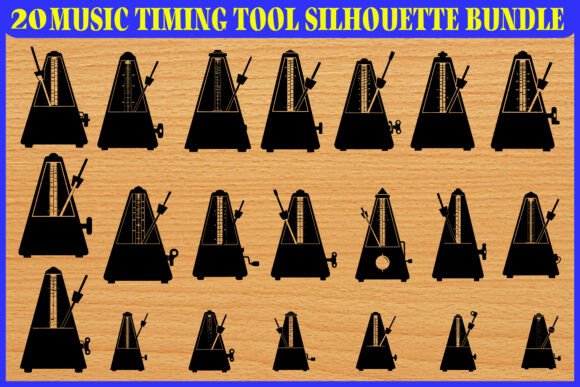
20 Music Timing Tool Silhouette Vector
Timing is everything in music—and in design. The 20 Music Timing Tool Silhouette Vector bundle delivers a precise, professional set of metronome-inspired icons that go beyond decoration. These aren’t generic clipart; they’re intentionally crafted vector silhouettes—clean, bold, and scalable—that communicate rhythm, tempo, and musical intention at a glance. Whether you’re building a lesson plan for middle-school band students or designing an intuitive UI for a new practice app, this collection offers visual clarity without compromise.
Why These Silhouettes Stand Out
Most timing-related graphics fall into one of two traps: overly technical (cluttered with dials, numbers, and labels) or too abstract (losing immediate recognition). The 20 Music Timing Tool Silhouette Vector avoids both. Each of the 20 designs maintains strong silhouette integrity—meaning they read clearly even at small sizes or in monochrome print. They vary thoughtfully: some emphasize classic pendulum motion, others suggest digital interface elements like toggle switches or pulse indicators, and a few reinterpret the metronome as minimalist geometry—circles, arcs, and rhythmic negative space.
Because they’re built as vectors—not traced raster images—they retain crisp edges at any scale. A metronome icon scaled to 16px works as a website navigation icon; enlarged to 24 inches, it holds up on a classroom poster. That scalability isn’t just convenient—it’s foundational for consistent branding across platforms.
Creative Applications You Can Start Today
This bundle thrives where function meets expression. Here’s how different users are already putting it to work:
- Educators: Embedding SVGs directly into Google Slides or Canva presentations to illustrate beat subdivisions—e.g., pairing a “60 BPM” silhouette with a visual timeline showing quarter-note spacing. One music teacher uses the PNG versions in editable PDF worksheets where students drag-and-drop tempo icons next to matching rhythmic phrases.
- App & Web Designers: Importing AI or SVG files into Figma or Adobe XD to build custom icon sets. Because each file includes transparent backgrounds and layered paths, designers easily recolor icons to match brand palettes—or animate them using CSS transforms (a subtle swing effect on hover, for instance).
- Merchandise Creators: Using EPS files for screen-printing on rehearsal shirts or tote bags. The bold outlines ensure clean ink registration, even on textured fabrics. A freelance illustrator recently combined three silhouettes into a seamless repeating pattern for drumhead decals—proof that utility doesn’t limit artistic reinterpretation.
- Content Creators & Bloggers: Dropping JPGs into blog posts about rhythm training or music tech tools—no need to credit or license separately. The high-res files embed cleanly in Substack newsletters or Medium articles, supporting visual storytelling without slowing load times.
How to Keep Your Projects Clear and Audience-Focused
Even great assets can get lost in clutter. To keep your use of the 20 Music Timing Tool Silhouette Vector effective:
- Match form to function: Use simpler silhouettes (like the single-pendulum or circular pulse icon) for UI buttons or mobile app icons—where recognition speed matters most. Save more detailed variants (e.g., those with gear motifs or dual-tempo dials) for posters, infographics, or printed handouts where viewers have time to absorb nuance.
- Maintain visual consistency: Pick 3–5 icons from the set that share similar line weight and proportion—and stick with them across a project. Avoid mixing ultra-thin and heavy-bold variants in the same document unless contrast serves a deliberate purpose (e.g., highlighting “slow vs. fast” in a comparison chart).
- Test legibility early: View your chosen icons at actual usage size—on a phone screen, projected in a classroom, or printed at 72 dpi. If details blur or shapes merge, scale back complexity. The strongest uses often rely on just one or two well-chosen silhouettes, not all twenty.
Practical Tips for Editing & Customization
You don’t need advanced design skills to adapt these files—but knowing what’s possible helps you move faster:
- All AI and EPS files open cleanly in Illustrator, CorelDRAW, and Inkscape. Paths are ungrouped by default, so changing stroke color or fill takes one click—not nested layer hunting.
- SVGs include accessible title tags (e.g., “Metronome Icon – 120 BPM”)—ideal if you’re adding them to educational websites where screen reader support matters.
- The included PDFs aren’t just previews—they’re print-optimized with crop marks and CMYK-ready color profiles, useful for quick mockups or client approvals before final press runs.
- Need to simplify further? Delete unnecessary anchor points in Illustrator using Object > Path > Simplify, or convert strokes to outlines for laser-cutting or embroidery digitizing.
Realistic Ideas for Low-Effort, High-Impact Use
You don’t need a full redesign to benefit. Try these immediately:
- Add the 90 BPM silhouette beside a “Moderato” heading in your next rehearsal schedule PDF—no extra explanation needed.
- Use the PNGs with transparent backgrounds to annotate audio waveforms in Audacity or Reaper screenshots—marking downbeat locations visually.
- Create a printable “Tempo Bingo” card for student warm-ups: fill a 5×5 grid with randomized silhouettes (each representing a different BPM range), then call out tempos as students mark matches.
- Drop the SVG into a Notion database as an inline icon next to “Practice Goal” entries—turning abstract targets (“Work on syncopation”) into tangible, visual anchors.
The 20 Music Timing Tool Silhouette Vector works because it respects both craft and context. It assumes you know your audience, your medium, and your goal—and gives you the visual vocabulary to act on that knowledge without distraction. No fluff. No forced trends. Just 20 thoughtful, ready-to-use interpretations of something fundamental: time, measured, made visible.