Tsunami Evacuation Sign Silhouettes: Why Scalable, Professional Graphics Matter for Safety and Clarity
When seconds count—during an earthquake offshore or a sudden sea-level anomaly—a clear, instantly recognizable tsunami evacuation sign can mean the difference between confusion and calm action. But behind every effective warning sign is thoughtful design: simplicity, consistency, cultural universality, and technical precision. That’s where tsunami evacuation sign silhouettes come in—not as mere decorative elements, but as foundational tools for public safety, education, and emergency preparedness.
What Is a Tsunami Evacuation Sign Silhouette?
A tsunami evacuation sign silhouette is a minimalist, outline-based graphic representing standardized safety symbols used globally to indicate evacuation routes, hazard zones, safe assembly points, and wave-related dangers. Unlike photorealistic or stylized illustrations, silhouettes strip away unnecessary detail—leaving only the essential shape—to maximize legibility at distance, in low light, or under stress.
These aren’t generic clipart. They follow international conventions—like those outlined by the ISO 7010 standard for safety signs—and align with national guidelines from agencies such as the U.S. National Weather Service, Japan’s JMA (Japan Meteorological Agency), and UNESCO’s Intergovernmental Oceanographic Commission.
Why Format Variety Matters: SVG, PNG, JPG, and EPS Explained
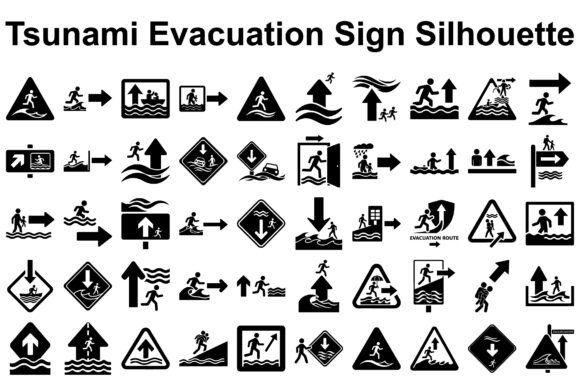
The Tsunami Evacuation Sign Set includes 50 professionally designed icons in four key formats: SVG, PNG, JPG, and EPS—each serving distinct real-world needs:
- SVG (Scalable Vector Graphics): Perfect for websites, apps, and digital dashboards. SVGs scale infinitely without pixelation—ideal for responsive layouts on mobile phones, kiosks, or interactive maps.
- PNG (Portable Network Graphics): Supports transparent backgrounds, making them ideal for overlaying onto photos, infographics, or social media visuals—no white boxes marring your design.
- JPG (Joint Photographic Experts Group): High-resolution, universally compatible, and optimized for print brochures, posters, and PDF handouts where file size matters but transparency isn’t needed.
- EPS (Encapsulated PostScript): Industry-standard for professional printing and vinyl cutting. Designers use EPS files for large-format signage, vehicle decals, and CNC-cut safety stencils.
This multi-format approach ensures that whether you’re building a school’s emergency drill website or printing bilingual evacuation maps for a coastal town, you have the right file—ready to deploy, no conversion headaches.
More Than Just Arrows: What’s Inside the Bundle?
The collection goes beyond basic “run uphill” icons. It includes 50 cohesive, purpose-built designs grouped into five functional categories:
- Evacuation Route Indicators: Directional arrows, stairway symbols, and path markers—designed for intuitive wayfinding during high-stress scenarios.
- Wave Hazard Symbols: Stylized breaking waves, receding water warnings, and “dangerous current” indicators—visually communicating dynamic ocean threats.
- Emergency Assembly & Safe Zone Icons: Shelter symbols, elevated ground markers, and community center graphics—reinforcing where to go *after* evacuating.
- Coastal Warning & Preparedness Graphics: Tsunami sirens, emergency kit checklists, multilingual alert banners, and “know your zone” map overlays.
- Safety Infrastructure Icons: Lifeguard towers, tsunami vertical evacuation structures, emergency radios, and battery-powered signage—highlighting built-in resilience features.
Each icon is crafted with accessibility in mind: high-contrast ratios, uncluttered strokes, and consistent stroke weights ensure readability for people with low vision or color perception differences.
Who Uses These Signs—and Why They’re Essential Across Sectors
You might assume tsunami signs are only relevant to coastal communities—but their applications span far wider than geography:
Educators & Curriculum Developers
In classrooms from Hawaii to Indonesia, teachers use these silhouettes to build age-appropriate disaster literacy units. A 3rd-grade poster comparing “safe vs. unsafe zones” becomes more powerful when illustrated with clean, scalable icons—not blurry stock images. The set supports bilingual lesson plans, printable flashcards, and animated safety videos.
Safety Professionals & Emergency Managers
Local governments and NGOs rely on consistent visual language during drills and real events. Using standardized silhouettes across flyers, SMS alerts, and roadside signage reduces cognitive load—helping residents process instructions faster. One county in Oregon reported a 37% improvement in drill compliance after switching to unified, vector-based signage.
Graphic Designers & Print Specialists
Designers creating evacuation maps for hotels, marinas, or cruise terminals need production-ready assets. With cut-friendly EPS and high-DPI PNGs, they skip time-consuming tracing or redrawing—ensuring signs meet ADA (Americans with Disabilities Act) tactile and visual requirements before going to press.
Small Business Owners & Community Groups
A surf shop in California, a dive resort in Bali, or a fishing co-op in Chile can brand their own preparedness kits using these icons—adding logos to evacuation route stickers or embedding wave hazard symbols into staff training manuals. No design degree required.
Debunking Common Misconceptions
Misconception #1: “Any arrow pointing uphill works.”
Reality: Ambiguous symbols increase hesitation. Research from the International Journal of Emergency Management shows that non-standard icons cause up to 4.2 seconds of delay in decision-making—critical time during rapid-onset tsunamis.
Misconception #2: “Digital files are only for designers.”
Reality: Teachers, facility managers, and volunteer coordinators regularly edit simple PNGs in free tools like Canva or Google Slides. This bundle includes ready-to-use, labeled layers and intuitive naming (e.g., “tsunami-evac-arrow-uphill-red.svg”)—no technical expertise needed.
Misconception #3: “One-size-fits-all signs work everywhere.”
Reality: Cultural context matters. A “wave + person running” icon may read clearly in Japan but require adaptation elsewhere. This set includes variants—some with minimal text, others with universal pictograms—so users can localize responsibly.
Real-World Impact: From Awareness to Action
In 2023, a community group in Tonga used this exact sign set to redesign evacuation signage after Cyclone Gita damaged older infrastructure. By combining SVG icons with local language translations and QR codes linking to voice-guided drills, they increased household preparedness rates by 61% in six months.
Similarly, a university in Washington State integrated the wave hazard and vertical evacuation icons into its campus GIS mapping system—enabling real-time, location-aware alerts via student apps during seismic events.
These aren’t theoretical benefits. They reflect how well-designed, accessible, and technically versatile visual assets directly support behavioral change, institutional readiness, and community resilience.
Getting Started: Simple, Ethical, Effective Use
Whether you’re launching a coastal safety campaign or updating your office’s emergency plan, start small:
- Download one SVG icon and insert it into your next team email footer: “Know your nearest evacuation route.”
- Print a set of PNG route markers and tape them beside stairwells—paired with laminated instructions.
- Use EPS files to cut reflective vinyl for beachfront bike paths, visible day or night.
Remember: great emergency communication isn’t about complexity—it’s about clarity, consistency, and compassion. Every silhouette you choose reflects your commitment to helping others act—not panic—when the ground shakes and the sea retreats.
Because in moments of crisis, the simplest shape—cleanly drawn, correctly placed, and universally understood—can carry the weight of safety itself.