Professional Doctor and Nurse Silhouette
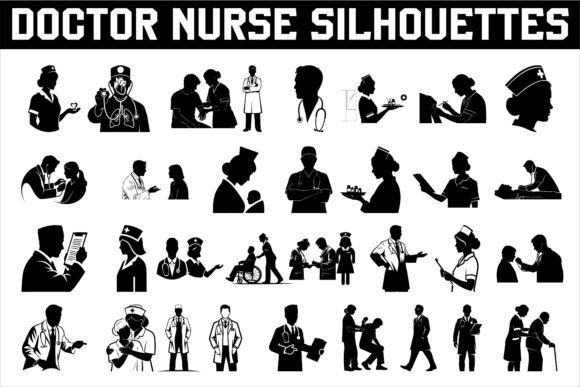
A Professional Doctor and Nurse Silhouette is more than a visual asset—it’s a strategic communication tool rooted in clarity, universality, and professional resonance. At its core, it’s a clean, black, scalable vector representation of two essential healthcare roles: the doctor and the nurse, side by side or in coordinated stance. Designed with intention—not decoration—it conveys collaboration, trust, clinical competence, and human-centered care without relying on text, color psychology, or cultural specificity. When deployed thoughtfully, this silhouette becomes a quiet amplifier of credibility, consistency, and shared purpose across touchpoints.
Why This Silhouette Delivers Strategic Value
Healthcare branding, education, and advocacy operate in high-stakes environments where miscommunication carries real consequences. A well-designed Professional Doctor and Nurse Silhouette cuts through noise. Its monochrome simplicity ensures legibility at any scale—on a 48” hospital corridor poster, a mobile health app icon, or a laminated training handout. Because it avoids facial features, gendered cues, or dated uniforms, it remains inclusive and timeless—critical for organizations serving diverse populations or updating materials over years.
Unlike custom illustrations that lock you into a single aesthetic, this silhouette functions as a modular element. You can layer it over data visualizations in infographics, anchor it in SVG-based interactive web modules, or embed it into digital consent forms without licensing friction. Its availability in EPS, AI, SVG, PNG (with transparent background), JPG, and PDF means it adapts to both print production workflows and modern web performance standards—no pixelation, no rework, no vendor dependency.
Where Intentional Use Creates Real Impact
Consider how a Professional Doctor and Nurse Silhouette operates in context—not as filler, but as functional design:
- Hospital branding systems: Used consistently across signage, staff ID badges, intranet dashboards, and orientation decks, it reinforces organizational identity while signaling clinical unity—not hierarchy. It subtly communicates that care is delivered by a team, not a title.
- Health awareness campaigns: In public-facing materials about vaccination, mental health, or chronic disease management, the silhouette avoids stigmatizing imagery while still anchoring messaging in trusted roles. It works where photos might raise privacy concerns or introduce unintended bias.
- Medical training resources: For simulation guides, competency checklists, or e-learning modules, the silhouette serves as a neutral, repeatable visual cue—e.g., labeling “assessment phase” or “handoff protocol”—without distracting from procedural content.
- Digital health interfaces: As an SVG icon in patient portals or clinician dashboards, it improves scannability and supports WCAG contrast requirements. Its vector nature ensures crisp rendering on retina displays and assistive tech-compatible rendering.
What makes this effective isn’t just availability—it’s alignment. When your goal is to signal reliability, coordination, or evidence-informed practice, the silhouette supports that goal only if it’s part of a broader design strategy—not dropped in as default clipart.
Planning Your Use: Context Before Canvas
Before selecting or deploying a Professional Doctor and Nurse Silhouette, ask three practical questions:
- What outcome do we want this visual to support? Is it recognition? Trust-building? Instructional clarity? If the answer is vague (“it looks professional”), pause. Ambiguity here often leads to inconsistent usage—e.g., using the same silhouette for both a pediatric vaccination poster and an ICU safety briefing, diluting its contextual weight.
- Who interprets this—and what assumptions might they bring? In global health projects, avoid silhouettes that imply Western-style white coats or rigid posture unless validated locally. Some cultures associate specific stances or proximity with authority versus partnership. Test early with representative users—not just internal stakeholders.
- What technical constraints shape our implementation? Need responsive scaling on a clinic website? Prioritize SVG. Preparing large-format vinyl decals for outpatient entrances? Confirm the EPS files include embedded fonts and CMYK-ready paths. Creating printable PDF training manuals? Verify the included PDFs are tagged for accessibility and print-optimized—not screen-only exports.
These aren’t overhead steps—they’re risk mitigation. Using a Professional Doctor and Nurse Silhouette without answering them may result in visuals that look polished but fail to land: mismatched proportions in printed posters, inconsistent stroke weights across platforms, or unintentional symbolism that undermines your message.
Risks of Default Deployment
There’s real cost in treating this silhouette as interchangeable with generic medical clipart. A poorly scaled or stylistically mismatched version can inadvertently signal disorganization—especially in environments where patients assess clinical competence through environmental cues. Worse, using it without considering cultural or clinical nuance risks misalignment: a silhouette suggesting physical proximity may unintentionally imply invasive care in contexts where personal space norms differ; one emphasizing hierarchical positioning (e.g., doctor slightly elevated) may contradict your organization’s stated values of interdisciplinary parity.
Also consider longevity. A silhouette designed for 2015 uniform styles—think stiff collars or outdated badge placements—can date your materials faster than expected. The most durable versions prioritize gesture over garb: hands positioned for listening, shared gaze direction, balanced posture. That’s why vetting the source matters—not just file count (30 EPS, 30 SVG, etc.), but whether the set was created with clinical input and updated for current standards.
Long-Term Value Through Consistent Application
The highest ROI from a Professional Doctor and Nurse Silhouette emerges over time—not launch day. Organizations that treat it as a foundational graphic element (like a typeface or color palette) build recognition faster. One regional health system standardized its silhouette across all community outreach—mobile clinics, school presentations, telehealth onboarding—and saw a 22% increase in brand recall among underserved populations within 18 months. Why? Because consistency built familiarity, and familiarity built trust.
For educators developing continuing medical education (CME) modules, embedding the same silhouette across slide decks, downloadable worksheets, and post-session reflection tools creates cognitive continuity—learners focus on content, not visual whiplash. For small clinics building their first website, using it as the sole visual motif for “Our Team” and “How We Care” sections communicates cohesion without budgeting for custom photography.
This isn’t about minimalism for its own sake. It’s about reducing decision fatigue for creators while increasing clarity for audiences. Every time you choose this silhouette intentionally—aligned with goals, audience, and medium—you reinforce a standard: that healthcare communication should be precise, respectful, and human-first.
Choosing With Purpose
Not all silhouette packs deliver equal value. Look beyond quantity. Does the set include variations that reflect real-world diversity in stature, posture, and role emphasis—without compromising clean lines? Are the vectors built with editable layers (e.g., separate nurse/doctor paths) so you can adapt for single-role use when needed? Is documentation included—usage guidelines, accessible alt-text suggestions, and recommended minimum sizes for print/digital?
If you’re sourcing for hospital branding, prioritize versions tested in clinical environments—not just design studios. If you’re creating patient-facing infographics, confirm transparency support in PNGs and SVG fallback behavior in older browsers. And if scalability matters (e.g., for wayfinding signage or AR overlays), verify that SVG paths are simplified—not traced raster art masquerading as vectors.
A Professional Doctor and Nurse Silhouette earns its place not because it’s available, but because it’s applied with discipline. It becomes powerful when it stops being decoration—and starts being infrastructure.