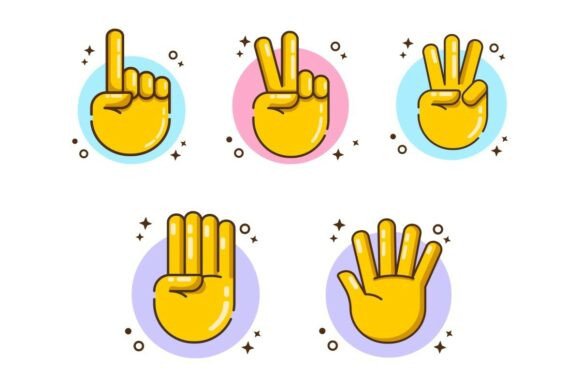
Set of Cartoon Hand Counting Icon
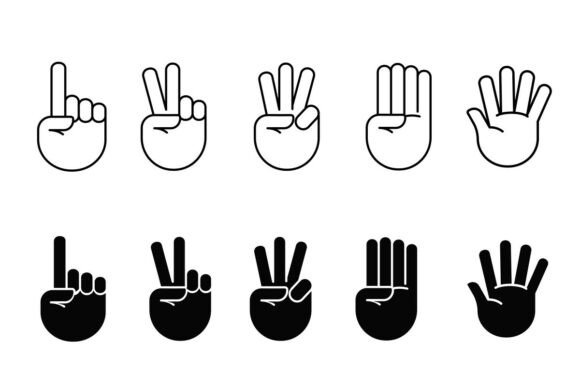
The Set of Cartoon Hand Counting Icon is a curated collection of vector illustrations depicting finger gestures for the numbers one through five. Each icon shows a simplified, stylized hand with fingers extended to represent a specific numeral—no text, no background, no embellishment. Designed in clean lines and balanced proportions, the set prioritizes clarity and immediate visual recognition. All files are delivered in SVG and EPS formats only—scalable, resolution-independent, and compatible with professional design and development workflows.
Why This Set May Be Relevant to Your Work
Designers, educators, and developers often seek visual tools that support early numeracy without cognitive overload. The Set of Cartoon Hand Counting Icon responds directly to that need. Its primary value lies in its focused scope: five distinct, consistent icons rooted in real-world counting gestures. Unlike generic number fonts or abstract symbols, these icons leverage embodied cognition—the idea that physical gestures reinforce conceptual understanding—making them especially useful in contexts where learners are still building foundational math awareness.
Key Benefits
- Clarity and consistency: Each hand is drawn with uniform stroke weight, rounded joints, and uncluttered negative space—supporting legibility at small sizes (e.g., mobile UI elements or flashcards).
- Educational alignment: Finger-counting is widely endorsed in early childhood curricula as a scaffold for number sense. These icons reflect standard, culturally neutral gestures—no thumbs-up interpretations or ambiguous configurations.
- Technical flexibility: SVG and EPS formats allow lossless scaling, easy recoloring via code or vector editors, and seamless integration into web, print, and app environments—no raster dependencies or licensing restrictions tied to font embedding.
- Workflow efficiency: Because the set contains only five icons, it avoids bloat. Designers can quickly locate, test, and iterate without sifting through dozens of stylistically inconsistent variants.
Tradeoffs and Considerations
While the Set of Cartoon Hand Counting Icon excels in specificity, its narrow scope also defines its limits. It does not include zero, six through ten, or alternate representations (e.g., closed fist for zero, “five” shown palm-forward versus palm-down). It also lacks contextual elements—no hands holding objects, no animated states, and no matching icons for operations like addition or subtraction. Users requiring broader numeric coverage or narrative illustration will need to supplement this set.
Additionally, the SVG/EPS-only delivery means users working exclusively in raster-based tools (e.g., older versions of Photoshop or certain classroom presentation software) may need to convert files—a minor but nontrivial step. There are no PNG previews or built-in color variants; customization requires basic vector editing knowledge.
When This Set Is a Strong Fit
The Set of Cartoon Hand Counting Icon works well in scenarios where simplicity, pedagogical fidelity, and technical reliability outweigh decorative complexity. For example:
- Early learning apps: Developers building iOS or Android apps for ages 3–7 can embed SVGs directly or export optimized assets per screen density—ensuring crisp rendering across devices.
- Printed educational materials: Teachers creating worksheets, number charts, or classroom posters benefit from EPS compatibility with desktop publishing tools like InDesign or Illustrator, preserving sharp edges when scaled for large-format printing.
- Accessible infographics: When illustrating progression (e.g., “Step 1: Show one finger”), the icons provide intuitive, language-agnostic cues—valuable for multilingual classrooms or learners with emerging literacy.
- UI components for accessibility tools: Teams designing assistive interfaces—such as AAC (augmentative and alternative communication) apps—can use these icons as neutral, recognizable touch targets aligned with motor-developmental norms.
When Alternatives May Be Worth Exploring
This set is less suitable if your project demands:
- Expanded numeric range: If you need representations beyond five—or want zero, ten, or teen numbers—you’ll likely need a larger icon family or custom illustration.
- Stylistic variety: Projects requiring thematic cohesion with other visual elements (e.g., animal motifs, seasonal themes, or branded character systems) may find the minimalist cartoon style too neutral or difficult to harmonize without additional art direction.
- Raster-first workflows: Educators or presenters relying heavily on PowerPoint or Google Slides who lack access to vector editors may prefer pre-exported PNG sets with transparent backgrounds and multiple sizes.
- Animated or interactive behavior: Since these are static vector files, adding hover effects, transitions, or gesture feedback requires separate front-end development—not something the icons themselves provide.
Making a Practical Decision
To determine whether the Set of Cartoon Hand Counting Icon aligns with your goals, ask yourself three questions:
- What’s the core learning or functional goal? If reinforcing one-to-five correspondence through gesture is central—and you don’t require supporting visuals for operations, place value, or higher numbers—this set matches that objective precisely.
- What tools and constraints shape your production pipeline? If your team uses Figma, Illustrator, or modern CSS/JS stacks—and you’re comfortable adjusting fills or exporting from vectors—the SVG/EPS format poses no barrier. If not, factor in time for conversion or training.
- How much visual extension does your project need? Review existing assets. Do you already have complementary icons (e.g., for “add,” “equal,” or “count”)? If so, this set integrates cleanly. If you’re starting from scratch and need full arithmetic coverage, consider whether combining this set with another resource better serves long-term scalability.
Finally, keep expectations grounded: this is a utility-focused asset—not a design system, not an animation toolkit, not a curriculum. Its strength is in doing one thing well: representing finger-counted numbers one through five with visual honesty and technical precision. When that matches your requirement, it reduces decision fatigue, streamlines implementation, and supports consistent, evidence-informed learning experiences.