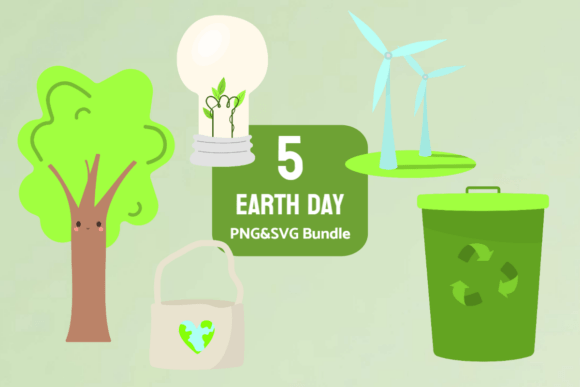
Green Energy Earth Day
Green Energy Earth Day isn’t just a theme—it’s a visual language for action. This second clipart bundle speaks directly to the quiet urgency of environmental stewardship, translating abstract ideals like “sustainability” and “renewable transition” into five clear, warm, and instantly legible illustrations. Designed with intention—not trend—the set leans into a friendly, modern flat style that avoids cartoonish oversimplification while remaining deeply accessible. There’s no forced whimsy here; instead, you’ll find thoughtful visual metaphors: a lightbulb cradling tender green leaves (not just “an idea,” but *a living, growing idea*), wind turbines standing tall but unobtrusive on sunlit grass, a tote bag where the Earth isn’t a globe—it’s a heart, stitched in empathy.
The palette grounds it all: forest green for stability and growth, lime for energy and freshness, soft neutrals to keep focus on the message—not the decoration. That balance makes these graphics work across contexts where tone matters as much as content. A classroom poster on solar adoption doesn’t need shouting; it needs clarity, warmth, and trust. A non-profit’s social media campaign for plastic-free April shouldn’t feel clinical—it should invite participation. Green Energy Earth Day delivers that quietly confident tone without leaning on clichés or stock aesthetics.
Where These Graphics Earn Their Keep
These aren’t decorative extras. They’re functional design assets—built to solve real communication problems. For educators, the smiling tree isn’t just charming; its expressive face helps younger audiences connect emotionally with conservation before they grasp complex systems. For small business owners launching a refill station or zero-waste pop-up, the reusable tote illustration gives instant visual shorthand—no caption needed—to signal values-aligned commerce. Bloggers covering eco-habits can drop the recycling bin graphic into a “5 Swaps That Actually Stick” post and immediately reinforce credibility through consistent, professional visuals.
Print designers will appreciate the 300 DPI PNGs—crisp even at poster size—and the SVG files, which scale flawlessly from Instagram story to trade show banner without pixelation or distortion. That scalability isn’t theoretical. Try placing the wind turbine graphic at 8% width in a newsletter sidebar: still legible. Then stretch it across a 48″ wide event backdrop: still clean, still balanced. That reliability is rare in eco-themed clipart, where many sets sacrifice detail for simplicity—or worse, lean too hard into “cute” at the expense of seriousness.
More Than Just Pretty Pictures
What makes Green Energy Earth Day especially useful for marketers and brand strategists is how each image supports narrative hierarchy—not just decoration. The lightbulb-with-leaves works as a section divider in an editorial layout about innovation in green tech; its shape naturally draws the eye downward, guiding readers into the next paragraph. The Earth-heart tote bag functions equally well as a call-to-action icon (“Bring your own bag”) or as a subtle watermark behind testimonials from sustainable brands. It’s versatile because it’s designed with purpose—not just aesthetic harmony.
And yes, the transparency matters. That clean PNG background means no time wasted masking or correcting edges in Canva or Figma. You drop it in, adjust opacity if needed, and move on. For time-pressed creators juggling multiple Earth Month campaigns, that efficiency compounds quickly—across flyers, email headers, workshop handouts, and digital ads.
Practical Pairing & Real-World Fit
These illustrations pair intuitively with clean, humanist sans serifs—think Inter, Poppins, or Montserrat—for body text and captions. Their flat geometry and open forms echo the clipart’s clarity without competing. Avoid overly geometric or condensed typefaces; they clash with the warmth embedded in the illustrations’ rounded corners and gentle line weights. If you’re designing a bilingual flyer, test readability at smaller sizes: the recycling bin symbol remains unmistakable even at 24px, thanks to bold negative space and strong silhouette definition.
Licensing is straightforward and commercial-ready—no attribution required, no hidden restrictions. Whether you’re a solo blogger monetizing a plastic-free living guide, a school district producing Earth Day curriculum, or a boutique skincare brand launching a refill program, the usage rights align with how people actually work. No fine print surprises. Just five high-fidelity, ethically sourced visuals—designed to support action, not just adorn it.
Why This Bundle Stands Apart
Most eco-themed clipart falls into one of two traps: either it’s so generic it blends into the background (generic leaves, vague globes), or it’s so stylized it limits application (overly detailed watercolor textures, niche art styles). Green Energy Earth Day avoids both by anchoring every image in function first. The smiling tree? Its expression is subtle—friendly but not childish—so it reads as approachable authority, not infantilization. The wind turbines? Proportionally accurate, grounded in landscape, not floating in conceptual space. That attention to contextual realism builds trust with adult audiences who’ve seen enough greenwashing to spot superficiality from a mile away.
It’s also intentionally restrained. Five images—not twenty—means each one carries weight. You’re not sifting through filler to find what works. You’re choosing from a tight, cohesive system where color, line weight, and symbolic logic are unified. That cohesion strengthens brand perception when used consistently across touchpoints: same green in a social post, same tote bag icon on a workshop badge, same lightbulb motif in a presentation slide. Consistency isn’t about repetition—it’s about recognition built on shared visual logic.
So whether you’re sketching a storyboard for an Earth Day webinar, laying out a community composting guide, or refreshing your brand’s sustainability page—these illustrations don’t ask you to adapt to them. They adapt to your voice, your audience, and your mission. Because going green isn’t about perfect graphics. It’s about clear signals, shared values, and the quiet confidence that comes from tools built to last—and to matter.