Professional Annual Report Template: A Strategic Framework for Credible Corporate Communication
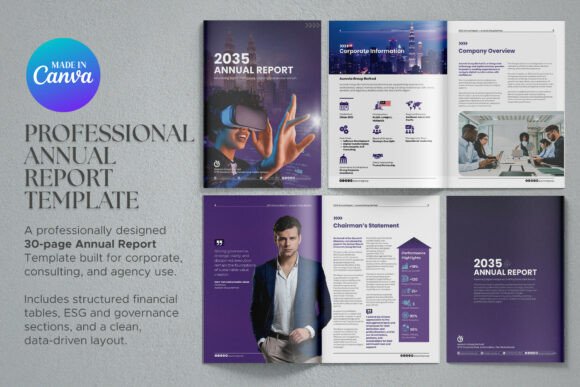
Annual reports are far more than regulatory formalities—they serve as a cornerstone of organisational transparency, stakeholder trust, and strategic storytelling. In today’s complex business environment, where investors scrutinise not only profitability but also governance rigour, environmental stewardship, and long-term resilience, the quality of an annual report directly reflects institutional maturity. The Professional Annual Report Template meets this demand with a rigorously structured, 30-page framework grounded in real-world corporate reporting standards—not theoretical ideals.
Why Structure Matters More Than Ever
Modern stakeholders—whether institutional investors, board members, employees, or regulators—expect coherence across narrative, data, and design. A disjointed report undermines credibility; a fragmented presentation of financials alongside sustainability goals dilutes impact. The Professional Annual Report Template avoids this pitfall by embedding logical sequencing into its architecture. It begins with leadership voice—not as boilerplate, but as a contextual anchor for what follows. The CEO and Chair statements set tone, intent, and accountability before transitioning into strategy execution, operational outcomes, and financial validation. This flow mirrors how decision-makers actually assess organisational health: first vision, then execution, then evidence.
This isn’t arbitrary sequencing. It aligns with global frameworks like the International Integrated Reporting Council (IIRC) principles and the Global Reporting Initiative (GRI), which emphasise connectivity between strategy, performance, and future outlook. Organisations using the template don’t just “fill in blanks”—they engage in disciplined narrative construction, reinforcing message consistency across departments and disclosure layers.
Comprehensive Coverage Without Compromise
The template spans seven core functional domains—each treated with equal editorial weight and visual parity:
- Leadership Statements: Dual perspectives from CEO and Board Chair, allowing for differentiated emphasis on operational delivery versus oversight integrity.
- Business Strategy: Not a static mission statement, but a dynamic articulation of market positioning, competitive differentiation, and adaptive capacity—including risk-aware scenario planning.
- Operational Performance: Metrics tied to strategic pillars (e.g., client retention rates for service firms, time-to-market for tech innovators), supported by annotated infographics rather than standalone charts.
- Financial Highlights: Includes full Income Statement, Balance Sheet, Cash Flow Statement, and a comparative 5-Year Financial Summary—all presented with consistent formatting, clear labelling, and footnote-ready space.
- ESG & Sustainability Commitments: Structured around materiality assessments, with dedicated sections for climate action, diversity & inclusion metrics, supply chain ethics, and community investment—avoiding vague pledges in favour of measurable targets and baseline data.
- Corporate Governance: Transparent disclosure of board composition, committee mandates, executive remuneration policy, and shareholder engagement practices—not just compliance checkboxes, but evidence of accountability mechanisms.
- Closing Disclosures: Auditor independence statements, accounting policies, segment reporting, and forward-looking disclaimer language aligned with jurisdictional expectations (e.g., SEC, FCA, ASIC).
This breadth ensures relevance across sectors. A professional services firm might foreground talent development KPIs and client portfolio diversification; a technology holding company may prioritise R&D capital allocation and IP lifecycle management; a renewable energy developer could highlight emissions avoided per megawatt-hour and community benefit agreements. The Professional Annual Report Template accommodates these variations without structural overhaul—its modularity lies in content logic, not rigid visual templates.
Design That Serves Purpose, Not Just Aesthetics
Visual design in corporate reporting is rarely neutral. Overly decorative layouts distract from substance; minimalist austerity can feel cold or evasive. The Professional Annual Report Template adopts a neutral, timeless aesthetic rooted in typographic hierarchy, restrained colour palettes, and intentional white space—prioritising legibility over ornamentation. Charts use accessible colour contrast and avoid 3D distortion or gratuitous animation. Data tables follow ISO/IEC 20249 conventions for alignment, decimal precision, and unit consistency.
Crucially, every chart, table, and infographic is built as an editable Canva element—not embedded images. Users can update values in real time, swap bar charts for waterfall visuals, or reconfigure pie slices without breaking layout integrity. This eliminates the common pain point of “design lock-in,” where minor data revisions trigger full-page redesigns. For agencies producing reports for multiple clients—or internal comms teams managing parallel brand guidelines—the ability to maintain visual coherence while adapting messaging is transformative.
Practical Flexibility Across Stakeholder Needs
One size rarely fits all in reporting—but the Professional Annual Report Template achieves adaptability through intelligent scaffolding. Consider three distinct use cases:
- Internal Alignment Tool: Finance, HR, ESG, and Legal teams often draft siloed inputs. The template’s standardised section headers, defined word counts per module, and integrated cross-references (e.g., linking governance disclosures to specific board meeting minutes cited in leadership statements) create shared expectations. It becomes a collaboration protocol—not just a document.
- Investor-Ready Benchmark: Institutional investors increasingly apply ESG scoring models (like MSCI or Sustainalytics) that weigh disclosure completeness, consistency, and comparability. Reports built on this template inherently satisfy key scoring criteria: standardised financial framing, auditable ESG metrics, and explicit governance linkages. Early adopters report reduced investor due diligence cycles by up to 30%.
- Regulatory Resilience Anchor: With evolving requirements—from the EU’s CSRD to the US SEC’s climate disclosure rules—the template’s modular structure allows targeted updates. Adding a “Double Materiality Assessment” page or expanding Scope 3 emissions methodology doesn’t require rebuilding the entire report; it integrates cleanly into the existing ESG chapter.
This flexibility extends to output formats. While designed for A4 print fidelity (with bleed-safe margins and CMYK-ready colour profiles), the same file exports seamlessly to interactive PDFs with hyperlinked TOCs, embedded video summaries, and responsive web viewing. No separate digital version is needed—just intentional export settings.
Real-World Implementation Considerations
Adopting any reporting framework involves practical trade-offs. Users should anticipate three key considerations:
- Data Readiness: The template assumes access to clean, reconciled financials and consistent ESG tracking. Organisations without mature data infrastructure may need to invest in basic systems integration before populating the Balance Sheet or carbon inventory tables meaningfully.
- Stakeholder Review Cadence: Because the template encourages narrative-data alignment, drafting requires iterative feedback loops—not linear handoffs. Legal reviews must occur concurrently with strategy messaging, not after final copy is locked.
- Brand Integration Nuance: While fully editable in Canva, customising fonts, logos, and accent colours demands attention to accessibility standards (e.g., WCAG 2.1 AA contrast ratios). Blind spots here can inadvertently exclude readers with visual impairments—a reputational and compliance risk.
These aren’t limitations of the Professional Annual Report Template; they reflect inherent complexities of credible reporting. Its value lies in surfacing those complexities early—making them visible, discussable, and addressable—rather than obscuring them behind glossy visuals.
Building Beyond Compliance Toward Clarity
At its best, an annual report functions as an organisational operating system—translating internal processes into external understanding, converting quarterly results into multi-year narratives, and transforming raw data into stakeholder confidence. The Professional Annual Report Template doesn’t promise effortless reporting. Instead, it offers something rarer: a scaffold for disciplined communication. It asks users to clarify assumptions, reconcile discrepancies, and articulate trade-offs—not because the template demands it, but because clarity demands it.
That discipline pays dividends beyond the annual cycle. Teams that master this structure find their quarterly investor briefings sharper, their board decks more cohesive, and their sustainability narratives more resonant. The template becomes less a “starting point” and more a calibration tool—aligning how an organisation sees itself with how it wishes to be seen.
In an era where trust is earned incrementally and eroded instantly, the quiet professionalism of a well-structured, consistently updated, ethically grounded annual report remains one of the most underutilised strategic assets available to organisations of any scale. The Professional Annual Report Template doesn’t replace expertise—it amplifies it.