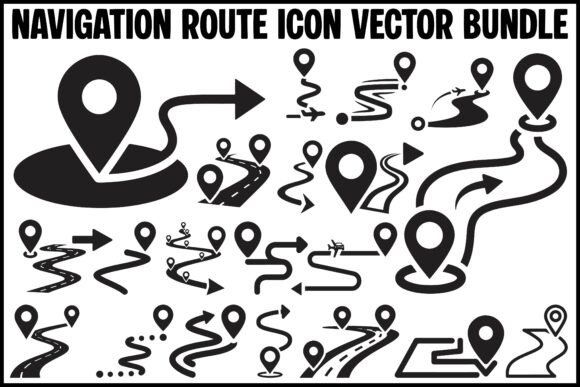
Navigation Route Icon Vector Bundle
If you’ve ever spent 20 minutes trying to find a clean, consistent set of map arrows or GPS-style location pins for a travel app mockup—or scrambled to resize a blurry pin icon for a printed city guide—you already know the quiet frustration of working with mismatched, low-res, or inflexible navigation assets. The Navigation Route Icon Vector Bundle solves that—not as a flashy gimmick, but as a quietly powerful toolkit built for real design work.
What It Actually Is (Beyond the Buzzwords)
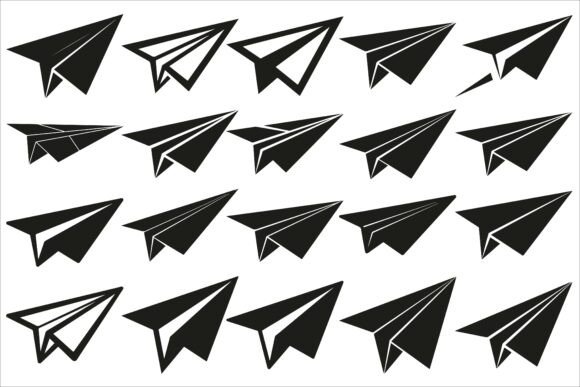
This isn’t just “a pack of icons.” It’s a thoughtfully curated collection of vector-based navigation symbols: route paths that curve and branch like real roads, directional arrows with intentional weight and flow, minimalist yet distinct location pins (📍), and subtle GPS-style markers—all unified in a clean black style. What makes it different is how it behaves: every element is fully editable in Illustrator, infinitely scalable without pixelation, and ready to adapt—whether you’re tweaking stroke width for a mobile UI or converting a path into a cut file for a travel-themed vinyl decal.
Where It Fits Into Real Projects
Travel bloggers and content creators use it to build custom illustrated maps for destination roundups—dropping stylized pins on SVG-based interactive blog graphics or layering transparent PNGs over drone photos in Canva. One client used the route paths to visualize a multi-stop hiking trail in a printable PDF guide; because the EPS files scaled cleanly to A3, the printed version held crisp detail even at 200% zoom.
App and SaaS designers rely on the SVG format for responsive web interfaces—especially when building trip-planning dashboards or fleet management tools. Since each arrow and path is a true vector shape (not a rasterized image), developers can apply CSS transforms, animate transitions between route segments, or dynamically recolor icons based on traffic status—all without loading separate asset files.
Educators and nonprofit communicators often need clear, accessible visuals for community walkability maps or public transit infographics. The bundle’s consistent line weight and uncluttered forms improve readability for all ages—and because the icons come with transparent PNGs, they drop cleanly onto illustrated neighborhood posters or slide decks without background cleanup.
Print designers and branding teams appreciate the EPS and PDF versions for large-format applications: think wayfinding signage for a campus tour, branded luggage tags with custom route motifs, or embroidered patches for outdoor gear brands. One regional tourism board used the location pin icons as base shapes—then added local landmarks (a lighthouse, mountain silhouette) inside the pin outline using Illustrator’s Pathfinder tool. That flexibility only works when the source is truly editable vector—not flattened layers or embedded rasters.
Who Benefits Most—and How Their Needs Differ
- Freelance UI/UX designers value speed *and* control: they grab the SVG files to drop into Figma or Sketch, then adjust color palettes in seconds to match a client’s brand guidelines—no hunting through 50 separate PSDs.
- Marketing managers building campaign assets often lack design software access—but the high-res PNGs let them drag-and-drop polished icons straight into PowerPoint presentations, Mailchimp newsletters, or social media carousels without asking their designer for every minor tweak.
- Small business owners launching local services (like bike tours, food crawls, or historical walking routes) use the bundle to create cohesive, professional-looking flyers and Instagram Story templates—even if they’re editing in free tools like Photopea or Cricut Design Space (which supports SVG import).
Things Worth Noticing Before You Use It
The Navigation Route Icon Vector Bundle shines brightest when your goal is clarity, consistency, and scalability—not decorative flair. It doesn’t include hand-drawn sketch styles, neon glows, or 3D effects. That’s intentional: this is infrastructure-level design, not decoration. If you need playful, illustrated icons for a children’s app, this might feel too restrained. But if you’re designing a municipal bike-share interface where users scan icons in under two seconds while biking, that restraint becomes a strength.
Also worth noting: while all formats are included, your workflow determines which ones matter most. If you’re designing exclusively for web, SVG and PNG cover 95% of use cases. If you’re prepping files for a print vendor, lean on EPS or PDF—they preserve vector fidelity and embed fonts correctly. And if you plan to modify shapes heavily (e.g., merging route paths with custom typography), the AI file is non-negotiable—it’s the only version where you can edit anchor points, adjust gradients, or change global swatches.
Why “Scalable” Isn’t Just Marketing Talk
Imagine placing a location pin on a tiny mobile screen versus a 6-foot-wide exhibition banner. With raster images, you’d need multiple sizes—and risk blurriness or jagged edges at larger scales. Here, one SVG file works at 16px and 1600px equally well. That same principle applies to color: instead of managing 10 shades of blue across 40 icons, you change one global swatch in Illustrator and update every route arrow, pin, and compass marker at once. It’s not magic—it’s vector logic, applied thoughtfully.
A Practical Detail Many Overlook
The clean black style isn’t arbitrary. It’s designed as a neutral foundation—not a final aesthetic. That means you’re not locked into a “look”; you’re given a reliable starting point. Want warm tones for a wellness retreat app? Recolor the SVG in seconds. Need high-contrast white-on-dark for a dashboard? Flip the fill and stroke. Prefer duotone treatment for a presentation? Apply two-color gradients directly to the vector paths. The simplicity serves adaptability.
When It Might Not Be the Right Fit
If your project requires icons with cultural specificity—say, traditional navigation symbols from Polynesian wayfinding or historic maritime charts—this bundle won’t meet that need. It’s modern, functional, and globally legible, not ethnographic. Likewise, if you need animated route tracing (like a moving dot along a path), the static vectors would require additional development work—you’d use these as base assets, then build animation on top.
But for the vast majority of digital products, marketing materials, educational resources, and small-business tools where users need to instantly recognize direction, location, and movement—the Navigation Route Icon Vector Bundle delivers exactly what it promises: no guesswork, no compromises, and zero visual noise.